Chime Unsolicited Text Messages Class Action: Full 2026 Legal Guide
If you received a text from a friend or family member inviting you to join Chime, and you never asked for that message, the chime unsolicited text messages class action may entitle you to $500. No account with Chime is required. No prior relationship with the company needed. Just one qualifying text received in Washington state could be enough.
What Is the Chime Unsolicited Text Messages Class Action?
The chime unsolicited text messages class action is a lawsuit filed in Washington state court against Chime Financial Inc. The case was brought by plaintiff Taft Charles and alleges that Chime violated Washington’s Commercial Electronic Mail Act, commonly known as CEMA, by sending promotional text messages to consumers who never consented to receive them.
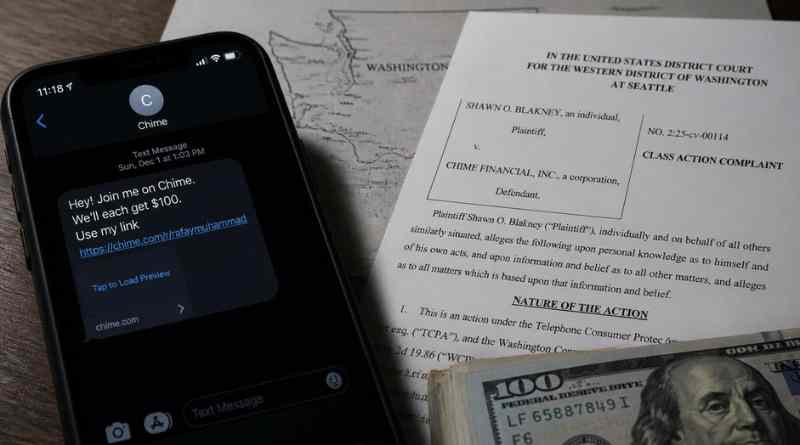
The texts at the heart of this case are not spam from an unknown company. They look personal. They come from a friend or family member’s actual phone number. The message reads something like: “We’ll both earn $100 when you join Chime and receive a qualifying direct deposit.”
That is Chime’s marketing language, delivered through your contact’s phone, using Chime’s own app infrastructure. The lawsuit argues that even though a real person hit send, Chime wrote the message, Chime built the system, and Chime paid the referral bonus. That makes Chime the legal originator of a commercial electronic message under Washington law, and Washington law requires prior consent before any such message can be sent.
No settlement has been reached as of June 2026. The case is active and open.
The Washington CEMA Law Explained
Most people have never heard of the Washington Commercial Electronic Mail Act. It is a state-level consumer protection law first enacted in 1998 to combat spam emails. In 2003, the state legislature amended it to cover unsolicited commercial text messages as well.
CEMA is stricter than federal law in two important ways. First, it gives individual consumers a private right of action, meaning you do not need a government agency to file on your behalf. You can be part of a class that sues directly. Second, it provides statutory damages of $500 per violation per recipient without requiring any proof of actual harm. You do not need to show that the text cost you money or caused measurable damage. Receiving one qualifying unsolicited commercial text in Washington is itself the violation.
The law covers anyone who initiates or assists in the transmission of a commercial electronic message. This broad definition is exactly what the plaintiff used to reach Chime. The argument is not that Chime’s users violated the law. The argument is that Chime, as the entity that designed the referral flow, pre-wrote the message, and financially incentivized its transmission, is the legal initiator under CEMA.
CEMA requires that commercial electronic messages be sent only to recipients who have given clear and affirmative advance consent, or with whom the sender has an established business relationship. Recipients who had no Chime account and gave no consent are the core focus of this lawsuit.
How Chime’s Referral Program Works and Why It May Be Illegal
Chime built a referral feature directly into its mobile app. When an existing Chime user opens the referral flow, the app prompts them to invite contacts from their phone. Chime pre-populates a text message with promotional language. The user selects contacts and taps send. The message goes out from the user’s real phone number.
The complaint in Taft Charles v. Chime Financial describes this as Chime gamifying the referral process. The $100 reward to the sender and $100 to the recipient creates financial pressure to blast the message to as many contacts as possible. Chime’s interface makes it easy to send the message to every person in your contact list with minimal friction.
The plaintiff’s legal argument is straightforward. Chime wrote the content. Chime controls what the message says. Chime set up the technical infrastructure. Chime pays the money that motivates the send. Under CEMA’s broad definition of initiating or assisting in the transmission of a commercial message, Chime is responsible for every text that went to a Washington resident who never consented.
The fact that the message appears to come from a friend does not protect Chime. It may actually make the violation worse, since the law also covers deceptive transmission paths that obscure the true commercial origin of a message.
Precedent Cases That Already Settled for Millions
The chime unsolicited text messages class action does not exist in a vacuum. Washington’s CEMA has been tested in court multiple times against companies running identical or near-identical referral text programs, and those cases have resulted in significant settlements.
In February 2024, a $9 million settlement was approved to resolve claims that Robinhood Financial violated CEMA through its own refer-a-friend text program. The structure of Robinhood’s referral system closely mirrors what Chime is accused of doing.
In mid-2025, Block, Inc., the parent company of Cash App, agreed to pay $12.5 million to settle a class action alleging that Cash App’s Invite Friends referral program violated CEMA by incentivizing users to send unsolicited promotional texts to Washington residents.
Both of those cases involved the same law, the same referral text structure, and the same consent argument now being applied to Chime. The Robinhood and Cash App settlements set a clear precedent and a realistic price range for what resolution in the Chime case could look like.
Given that Chime has a large national user base and an aggressively promoted referral program, the volume of potentially qualifying texts sent to Washington residents could be substantial.
Who Qualifies for the Chime Class Action
Based on the complaint and CEMA’s requirements, you are likely a potential class member if all of the following apply to you.
You are a Washington state resident. CEMA is a Washington state law and the class is limited to Washington recipients. If you live outside Washington, this particular lawsuit does not cover you, though federal TCPA protections may still apply depending on the circumstances.
You received a text message inviting you to join Chime. The message was sent through the Chime referral program and arrived on your cell phone from a friend or family member’s number. It likely included language about earning $100 when you sign up and receive a qualifying direct deposit.
You never had a Chime account and never consented to receive commercial messages from Chime. This is the core of the claim. If you were not an existing Chime customer and you received this referral text, you had no established relationship with Chime and gave no advance consent.
You still have the message. This is not a hard legal requirement but it significantly strengthens your ability to participate. Attorneys investigating this case specifically ask that you keep the original text if you have it. Screenshots of your message history showing the Chime referral text are valuable evidence.
No formal class certification has occurred yet as of June 2026. The precise eligibility criteria will be established as the case progresses through the courts.
What You Could Recover
Under CEMA, each unsolicited commercial text message sent to a Washington resident without consent is a separate $500 violation. You do not need to prove you were damaged beyond receiving the message. The statute creates the right to recovery automatically.
If you received multiple referral texts from different Chime users on different occasions, each qualifying message may count as a separate violation, potentially multiplying your recovery.
In practice, class action settlements reduce individual payouts based on total claims filed. The Robinhood settlement resulted in payments to a large class of Washington residents. The Cash App settlement did the same. What each individual received depended on how many people filed claims against the fund.
No settlement amount has been announced in the Chime case as of this writing. The $9 million figure that appears in early reporting appears to reference the Robinhood settlement as a comparable benchmark, not a confirmed Chime fund. Do not rely on any specific number until a settlement is formally announced and approved by the court.
What Chime Is Facing Beyond This Lawsuit
The chime unsolicited text messages class action is not the only legal problem Chime is managing in 2026. On April 3, 2026, plaintiffs Cindy Castaneda and Lauren Goodloe filed a separate class action in the U.S. District Court for the Northern District of California, Case No. 3:26-cv-02924, alleging that Chime failed to protect customer data during a breach that occurred on or around April 1, 2026. That breach, attributed to a group identified as Team 313, caused a platform-wide outage that left thousands of users unable to access accounts, view balances, or send money.
The two lawsuits are independent. One targets Chime’s referral text marketing practices under Washington state law. The other targets Chime’s data security infrastructure under federal and state privacy laws. Both are active and unresolved.
For consumers tracking the chime unsolicited text messages class action specifically, the data breach case is separate and does not affect your eligibility or potential recovery in the text message lawsuit.
What You Should Do Right Now
If you are a Washington resident who received a Chime referral text, take these steps now.
Keep the original text message. Do not delete it. Take a screenshot and save it in multiple places. The exact wording of the message, the phone number it came from, and the date it was received are all potentially relevant to your claim.
Register your information with attorneys investigating the case. ClassAction.org has an active investigation page for this lawsuit. Filling out their form does not commit you to anything but it connects you with the legal team and ensures you are on record if a class action is filed and a settlement is reached.
Do not ignore class notices when they arrive. If a settlement is reached and you qualify as a class member, you will receive a notice by mail or email. That notice will contain a deadline. Missing the deadline eliminates your right to recover.
You do not need to hire an attorney on your own to participate in a class action. If a settlement is reached, class counsel handles the legal work on behalf of all class members. Individual class members typically receive their share after the settlement is approved and claims are processed.
Why This Case Matters for Fintech Companies Nationwide
The chime unsolicited text messages class action is part of a broader pattern of referral program litigation under Washington’s CEMA. Robinhood paid $9 million. Cash App paid $12.5 million. Both used the same refer-a-friend text structure that Chime is now defending.
This pattern matters because it tells every fintech company in the country that Washington’s anti-spam law has teeth. You cannot outsource your marketing to your existing users by incentivizing them to spam their contacts and then claim you are not the message sender. CEMA’s definition of initiating or assisting transmission is broad enough to reach the company behind the button.
For consumers across Washington, the message is simpler. A text you did not ask for from a company you never dealt with may be worth $500. The law exists. Attorneys are actively investigating. If you have that text on your phone, your next step is clear.
Frequently Asked Questions
What is the chime unsolicited text messages class action?
It is a lawsuit filed in Washington state court by plaintiff Taft Charles against Chime Financial Inc. It alleges Chime violated Washington’s Commercial Electronic Mail Act by using its referral program to send promotional text messages to Washington residents who never consented to receive commercial messages from Chime.
Do I need to have a Chime account to qualify?
No. The lawsuit specifically targets people who received referral texts but never had a Chime account and never gave consent to receive commercial messages from the company. Non-customers are the primary class focus.
How much money can I get?
CEMA provides $500 in statutory damages per qualifying text message received. If a settlement is reached, individual payouts will depend on how many class members file claims. No settlement has been announced as of June 2026.
Is there a deadline to file?
No filing deadline exists yet because no settlement has been finalized. Monitor official case updates and attorney investigation pages. When a settlement is reached, a claim deadline will be set and you must meet it to participate.
What if I deleted the text?
Keeping the original message strengthens your claim, but its absence alone does not automatically disqualify you. Self-certification may be legally sufficient. Contact the attorneys investigating the case for guidance specific to your situation.
Final Word
The chime unsolicited text messages class action is a live legal case backed by strong precedent and a clear legal framework. Robinhood and Cash App already paid out combined settlements of over $21.5 million under the same law for the same type of referral text program. Chime runs an identical system.
If you are a Washington resident who received a Chime referral text from a friend or family member and never signed up for the service, your rights under CEMA are clear. Keep the message. Register your information. Watch for settlement notices. The legal process is slow, but for cases like this one, it produces results.