Michael Oher Lawsuit: Complete Case Breakdown and 2026 Status
The michael oher lawsuit is a closed legal matter that began on August 14, 2023, when former NFL offensive tackle Michael Oher filed a petition in Shelby County, Tennessee probate court against Sean and Leigh Anne Tuohy, the couple whose relationship with Oher inspired the 2009 film The Blind Side. The petition alleged that the Tuohys deceived Oher into signing conservatorship papers at age 18 by telling him the documents were equivalent to adoption papers, then used the conservatorship to profit from his name, image, and likeness, including millions of dollars in film royalties, without sharing those earnings with him. A Tennessee judge terminated the conservatorship in September 2023, removing the Tuohys’ legal authority over Oher’s financial affairs. The financial claims were resolved through a confidential private settlement reached in the months that followed. As of 2026, no active litigation between Oher and the Tuohys remains on any court docket. The case is closed.
Who Is Michael Oher and What Is the Connection to The Blind Side?
Michael Oher is a former NFL offensive tackle who played nine seasons in the league, spending five seasons with the Baltimore Ravens, one season with the Tennessee Titans, and two seasons with the Carolina Panthers before his career ended in 2016. He was born in Memphis, Tennessee, grew up in a severely impoverished household, and experienced periods of homelessness during his childhood before being taken in by Sean and Leigh Anne Tuohy.
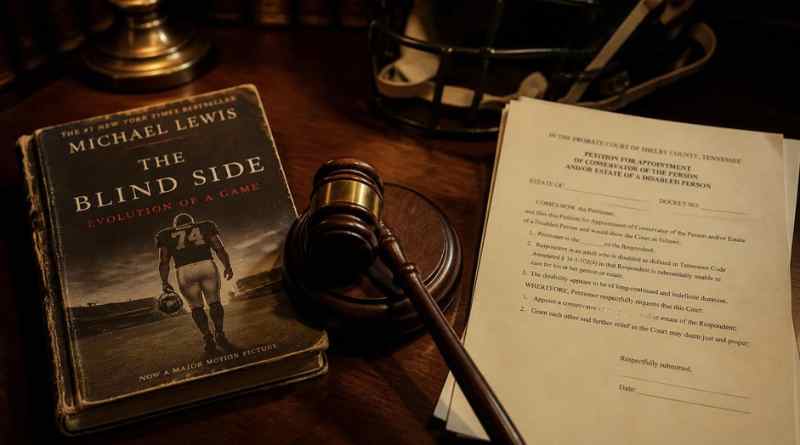
His story was first told in the 2006 book The Blind Side: Evolution of a Game by bestselling author Michael Lewis. The book covered both the evolution of the left tackle position in professional football and Oher’s personal journey. The 2009 film adaptation, titled The Blind Side, starred Sandra Bullock as Leigh Anne Tuohy and won Bullock the Academy Award for Best Actress. The film earned $309 million worldwide at the box office, making it one of the highest-grossing sports films in history.
For over a decade following the film’s release, the narrative of the Tuohys welcoming Oher into their family and helping him rise from homelessness to NFL success was treated as one of the most inspiring stories in American sports. That narrative was fundamentally challenged when Oher filed his lawsuit in August 2023 and disclosed what he described as the truth about his legal relationship with the Tuohys.
The Central Legal Allegation: Conservatorship vs. Adoption
The michael oher lawsuit turned on a specific and legally consequential distinction that most people, including Oher himself for many years, were not aware of.
When Oher was 18 years old in 2004, he signed legal documents establishing a conservatorship with Sean and Leigh Anne Tuohy as his conservators. A conservatorship is a court-ordered arrangement that gives the appointed conservators legal authority to manage the financial and in some cases personal affairs of another person. It is a relationship between a guardian and a ward, not between parents and a child.
Adoption in Tennessee, and in most states, creates a legal parent-child relationship. It permanently integrates the adopted person into the adopting family’s legal structure and carries with it inheritance rights, the right to use the family name, and a full familial legal status. Critically, Tennessee law permits adult adoption, meaning the Tuohys could legally have adopted Oher as an adult if they had chosen to do so.
The legal distinction between conservatorship and adoption that matters most for the financial claims in the michael oher lawsuit is this: as conservators of an adult, the Tuohys had the legal authority to enter into contracts and make financial decisions on Oher’s behalf. As adoptive parents of an adult, they would have had no such authority. The conservatorship structure gave the Tuohys contractual signing authority over Oher’s name, image, and likeness that adoption would not have provided once he was a legal adult.
Oher’s petition stated that he did not understand he was signing conservatorship papers at 18. He alleged that the Tuohys told him signing these documents was equivalent to adoption, making him a legal member of their family. He discovered the difference, according to court filings, only in February 2023, when he learned for the first time that the conservatorship he had signed had never made him anyone’s adopted son in any legal sense.
What Oher Claimed the Tuohys Did With the Conservatorship
The financial core of the michael oher lawsuit was Oher’s allegation that the Tuohys used their conservatorship authority to negotiate and profit from deals connected to his name, image, and life story, including but not limited to the rights to The Blind Side film, without sharing those profits with him.
Oher’s petition alleged that the Tuohys and their biological children received substantial financial compensation from The Blind Side film while Oher received little or nothing from a deal structured around his own life story. The petition sought a full accounting of all money earned from Oher’s name, image, and likeness over the nearly 19 years the conservatorship had been in place, an injunction prohibiting the Tuohys from any further use of his name, image, and likeness, compensatory damages, punitive damages, and costs and attorney fees.
The Tuohys denied these allegations directly and specifically. In their September 2023 court filing, they stated there was never any intent to adopt Oher and vehemently denied ever telling Oher that they intended to legally adopt him. They maintained that the conservatorship was established to assist Oher with practical matters including a driver’s license, health insurance, and the college admissions process at Ole Miss, the university both Sean and Leigh Anne Tuohy had attended. They claimed Oher had always been fully informed about the nature of the arrangement.
On the financial question, Sean Tuohy stated publicly that the family earned approximately $500,000 from The Blind Side film, that this was split evenly among all family members including Oher, and that each family member therefore received approximately $100,000. These figures were directly contested by Oher’s legal team.
The Tuohys also alleged, through public statements, that Oher had attempted to extort $15 million from them before filing the lawsuit, threatening to go public with his accusations if the payment was not made. Oher’s legal team denied this characterization.
Why Oher Took Nearly Two Decades to File the Lawsuit
One of the most widely asked questions about the michael oher lawsuit is why Oher waited so long to file, given that the conservatorship was established in 2004 and the film was released in 2009.
Oher addressed this directly in an August 18, 2024 interview with The New York Times. He explained that during his NFL career he had deliberately set aside concerns about things off the field because professional football requires complete focus. In his words, pro football is a hard job. You have to be locked in 100 percent. He added that he went along with the Tuohys’ narrative because focusing on his career required setting aside other issues.
He also stated clearly in this interview that the lawsuit was not motivated by a need for money, saying he had worked hard and saved his earnings from his NFL career and had millions of dollars. The motivation he described was about truth, legal rights, and correcting what he viewed as a false and exploitative narrative built around his life story.
The September 2023 Termination of the Conservatorship
One of the fastest and least disputed outcomes of the michael oher lawsuit was the termination of the conservatorship itself. In September 2023, within weeks of Oher filing his petition, a Tennessee probate court judge signed an order formally ending the conservatorship. This removed all legal authority that Sean and Leigh Anne Tuohy held over Oher’s financial affairs, approximately 19 years after the conservatorship had been established.
The termination of the conservatorship was not contested by the Tuohys in the same way that the financial claims were. Once both parties’ legal positions were made public and the court proceedings began, the legal mechanism giving the Tuohys financial authority over Oher’s life came to an end relatively quickly.
The Financial Claims: Discovery, Forensic Accounting, and Private Settlement
With the conservatorship terminated, the remaining legal battle concerned the financial claims, specifically what profits had been generated from Oher’s name, image, and likeness during the conservatorship period, whether those profits were properly shared with Oher, and whether the Tuohys had breached their duties as conservators.
These claims were complex. They required forensic accounting of earnings from the book, the film, related merchandise, promotional appearances, and any other commercial arrangements structured around Oher’s story over nearly 19 years. The discovery phase of the proceedings, during which both sides produced financial documents, bank records, contracts, and internal correspondence, occupied most of 2024 according to multiple sources reviewing the public court record.
Rather than take these complex financial questions to a public jury trial, both parties ultimately chose to resolve the matter through a confidential private settlement. The exact terms of the settlement, including any financial compensation paid to Oher, were kept confidential under non-disclosure terms agreed to by both parties. No court judgment specifying a dollar amount was entered. Neither side has publicly confirmed what financial resolution was reached.
What is confirmed across multiple sources is that the settlement resolved all financial claims between the parties, that neither side can relitigate the same claims going forward, and that the Tuohys no longer have any legal authority over Oher’s affairs. By mid-2024, public court records in Shelby County showed no active filings in the case. By 2025, both sides had moved forward from active litigation.
What the Settlement Did Not Produce: No Public Vindication
One of the defining characteristics of how the michael oher lawsuit concluded is that neither side obtained the outcome that a trial might have delivered.
Oher did not receive a court ruling on the merits of his exploitation claims. No judge or jury publicly declared that the Tuohys had deceived him, misappropriated his earnings, or breached their duties as conservators. His story about what happened was never adjudicated in a public proceeding with findings of fact.
The Tuohys similarly did not obtain a dismissal of Oher’s claims or a judicial finding that their conduct was appropriate. A dismissal on the merits would have created a public record that the court found the exploitation allegations unfounded. No such record exists. The case ended through mutual agreement, not through a court resolving who was right.
This outcome is legally common but emotionally unsatisfying for observers who followed the case. Confidential settlements preserve both parties’ dignity and avoid the risk and expense of trial, but they leave the public factual record permanently incomplete. The financial terms that would most illuminate what actually happened inside the 19-year relationship between the Tuohys and Oher remain private.
The Broader Impact: Conservatorship Reform and Sports Law
The michael oher lawsuit has had a documented impact beyond the immediate dispute between Oher and the Tuohys, generating serious legal and policy discussions in two specific areas.
Conservatorship reform became a more prominent legislative issue following the case. The Oher lawsuit, arriving in the wake of the high-profile Britney Spears conservatorship case from which Spears was freed in 2021, added significant momentum to advocacy for stronger judicial oversight of conservatorships, mandatory periodic review of arrangements involving adults with full cognitive capacity, and enhanced disclosure requirements at the time conservatorship documents are signed. Legal reform advocates specifically cited the Oher case as an example of how a conservatorship established for ostensibly practical and helpful reasons could, over time, create financial arrangements that disadvantaged the conservatee.
Sports and entertainment law received renewed attention from the case regarding how athletes and their families or legal representatives negotiate rights to life story adaptations. The case raised the question of whether Oher, as the person whose life story formed the basis of a book and a $309 million grossing film, received a fair share of the commercial value generated from that story, and whether the legal mechanism used to structure those arrangements gave him adequate independent legal counsel and bargaining power.
Intellectual property attorneys commented extensively during the case about the complexity of life rights agreements, noting that the question of who owns the right to benefit commercially from their own life story when that story has been contractually licensed to others involves layers of legal analysis that most individuals, without specialized legal representation, are poorly positioned to navigate.
Frequently Asked Questions
What was the michael oher lawsuit about?
Michael Oher filed a petition in August 2023 in Shelby County, Tennessee, alleging that the Tuohys deceived him into signing a conservatorship at age 18 by telling him it was equivalent to adoption, then used the conservatorship to profit from his name, image, and likeness, including through The Blind Side film, without sharing those earnings with him. He sought termination of the conservatorship, an accounting of all profits earned from his story, an injunction against further use of his name and likeness, and compensatory and punitive damages.
How was the michael oher lawsuit resolved?
The conservatorship was formally terminated by a Tennessee judge in September 2023. The financial claims were resolved through a confidential private settlement reached in the months that followed, with the settlement’s specific financial terms undisclosed. The case is fully closed as of 2026 with no active filings on any court docket.
How much money did Michael Oher receive in the settlement?
The financial terms of the settlement are confidential. No court judgment specifying a dollar amount was entered, and neither party has publicly confirmed what Oher received. Media reports speculated about a figure in the range of several million dollars, but these figures were not confirmed by Oher’s team, the Tuohys, or the court.
Did the court rule that the Tuohys exploited Michael Oher?
No. The case was resolved through a private settlement before any trial or judicial ruling on the merits of the exploitation claims. No judge or jury publicly adjudicated whether the Tuohys had deceived Oher or improperly profited from his story.
What was the Tuohys’ defense in the lawsuit?
The Tuohys denied all allegations. They maintained the conservatorship was established to help Oher with practical matters including a driver’s license, health insurance, and college admissions, that Oher had always been informed about its nature, that profits from The Blind Side were shared equally with Oher, and that Oher attempted to extort $15 million from them before filing the lawsuit. Oher denied the extortion allegation.
Is The Blind Side film still available to watch?
The film remains available on streaming platforms. Neither the lawsuit nor the settlement included any provision removing the film from distribution.
Final Word
The michael oher lawsuit told one of the most unexpected legal stories in American sports in 2023 and 2024, fundamentally challenging a cultural narrative that millions of people had embraced as a straightforward story of generosity and redemption. What the legal proceedings confirmed is that the conservatorship was real, that it gave the Tuohys legal authority over Oher’s financial affairs from the time he was 18 until 2023, and that the legal relationship between Oher and the Tuohys was structurally different from the adoptive family narrative that The Blind Side presented on screen.
What the proceedings did not confirm, because they ended in a private settlement before any merits ruling, is exactly how much money was generated from Oher’s story, how much Oher received, or whether the financial arrangements were lawful and fair. Those questions remain unanswered in any public court record, which is precisely why the case continues to generate questions even after the legal proceedings have concluded.
Note: This article is for informational purposes only and does not constitute legal advice.