
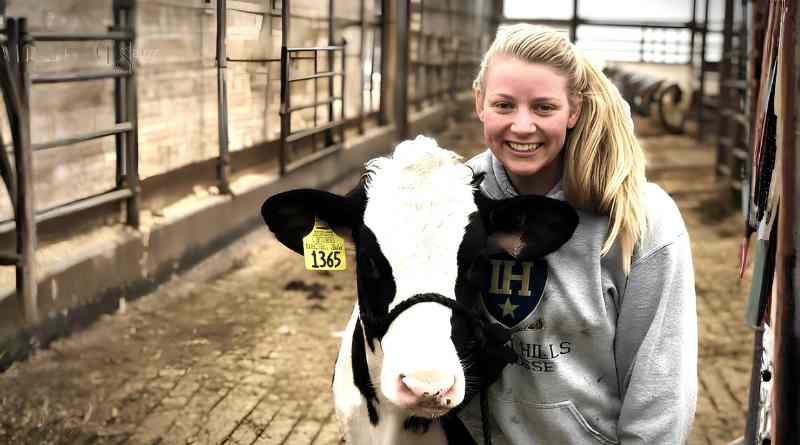
Katy Davis Suffield: Connecticut’s Agriscience Educator
Katy Davis Suffield is a certified agriscience educator at the Suffield Regional Agriscience Center in West Suffield, Connecticut. She teaches plant science, animal science, and agricultural biotechnology at the high school level, and serves as the FFA chapter advisor, curriculum leader, and a state-level advocate for agriscience program funding.
- UConn B.S. Agriculture & Natural Resources
- 20+ CT regional agriscience centers served
- 2017 Earliest verified public record
- 2025 Iceland student expedition led
Who is Katy Davis Suffield?
Most people who search this name are looking for a celebrity or social media personality. They won’t find one, and that’s exactly the point. Katy Davis Suffield is a working agriscience educator whose career has been built inside classrooms, greenhouses, livestock facilities, and Connecticut state legislative halls. Her influence is real, just local, the kind that shapes students and programs rather than trending timelines.
Publicly verified records place her on the staff page of Suffield High School’s agriscience program, listed among FFA advisors, and cited in Suffield Board of Education meeting minutes. She is not a myth. She is not a manufactured internet profile. She is an educator doing serious, documented work in agricultural science education in one of Connecticut’s most well-regarded regional agriscience programs.
Growing up in Central Connecticut, a region where farming traditions and rural land use remain embedded in daily life, gave Davis an early, organic exposure to agricultural systems. That foundation steered her toward a field that combines hard science with community responsibility.
The public trail around Katy Davis Suffield is school-centered, not personality-centered. Board minutes, agriscience program pages, FFA listings, and UConn Extension outreach records form the factual core of her public identity.
Education & Academic Background
Davis earned her Bachelor of Science in Agriculture and Natural Resources from the University of Connecticut. UConn’s agricultural programs are among the most respected in the Northeast, offering students direct exposure to applied farming systems, environmental science, soil management, and modern agricultural technology, a curriculum that maps directly onto what Davis delivers to her students today.
Her academic path also included hands-on farm training and outreach experience through UConn Extension, the university’s public engagement arm that connects agricultural research to real communities across Connecticut. That dual exposure, rigorous coursework paired with farm-floor practicality, formed the instructional philosophy she carries into every lesson at Suffield.
She also holds a commercial driver’s license (CDL), which allows her to transport students to competitions, fairs, and agricultural field experiences, a practical credential that reflects the operational reality of rural education programs where transportation access shapes student opportunity.
The Suffield Regional Agriscience Center
The center where Katy Davis Suffield teaches is not a standard high school elective program. The Suffield Regional Agriscience Center sits inside Suffield High School but functions as a distinct, regionally-serving Career and Technical Education (CTE) hub. It draws students from multiple school districts across the area and offers specialized tracks that go well beyond introductory agriculture.
Plant science
Greenhouse management, horticulture, crop biology
Animal science
Livestock systems, veterinary concepts, animal behavior
Ag biotechnology
Lab-based genetics, biotech applications in farming
Environmental studies
Sustainability, natural resource management, ecology
Ag business
Farm economics, market systems, agri-entrepreneurship
The facility includes dedicated labs, greenhouse space, and livestock infrastructure, giving students access to professional-grade environments that mirror real agricultural operations. For many students, the program represents their first meaningful exposure to the career pathways available within modern agriculture, environmental science, and agri-business.
Teaching Philosophy & Classroom Approach
Davis teaches the way she was taught, through direct experience. Her classroom model is built on the principle that agricultural science is learned by doing, not just reading. Lessons regularly extend beyond the four walls of a classroom into greenhouse projects, field labs, and supervised hands-on work with plants and animals.
This approach falls under what educators call project-based learning (PBL) and experiential education, two models consistently shown by research to improve knowledge retention, especially in technical and applied science subjects. For Katy Davis Suffield, it is not a pedagogical trend to adopt. It is simply how agricultural education works when done well.
Students in her program are guided through Supervised Agricultural Experience (SAE) projects, individual, student-driven endeavors that let learners explore a specific agricultural interest over an extended period. These projects often evolve into college application centerpieces and early career portfolio work. She creates structured environments where failure is part of the learning process, and problem-solving skills are built iteratively through lab work, field observation, and competitive events.
Precision agriculture tools and modern biotech concepts are woven into her curriculum, a deliberate choice that prepares graduates for the agricultural industry as it actually exists today, not as it operated a generation ago.
FFA Leadership & Student Mentorship
Davis serves as the advisor for the Suffield FFA chapter, one of the most consequential roles an agriscience teacher can hold. The Future Farmers of America (FFA) is the premier agricultural student organization in the United States, offering leadership development, competitive events, community service, and scholarship pathways for high school students in agriscience programs.
Under her advising, Suffield FFA members compete at high-profile agricultural events including The Big E, the Eastern States Exposition held annually in West Springfield, Massachusetts, one of the largest agricultural fairs in the country. Competition at this level demands preparation, technical knowledge, and presentation skills that extend well beyond standard classroom achievement.
Her mentorship role is not ceremonial. She guides students through the full arc of the FFA experience, from selecting competitive events, to building SAE projects, to applying for state and national FFA degrees. For students in Suffield and surrounding districts, her involvement in FFA directly translates to scholarship eligibility, college readiness, and professional connections in Connecticut’s agricultural sector.
State-Level Advocacy Work
In March 2022, Katy Davis Suffield stepped into a significantly more public role when she testified before the Connecticut state legislature in support of House Bill 5283. The bill addressed funding for regional agriscience centers statewide, a policy issue with direct consequences for programs like the one she runs at Suffield.
Her testimony made the case for what agriscience centers deliver that standard classroom science cannot: real facilities, specialized equipment, livestock, working greenhouses, and technically trained educators who hold dual knowledge of both pedagogy and agricultural science. Connecticut operates more than 20 such centers. All of them depend, in part, on consistent state funding to remain operational at a level that justifies their regional structure.
Her 2022 legislative testimony on House Bill 5283 is one of the strongest documented examples of Davis operating outside the classroom in a public advocacy capacity, using firsthand professional knowledge to shape education policy at the state level.
That kind of advocacy is rare among classroom teachers. It reflects a long-term investment in the structural health of agriscience education in Connecticut, not just the day-to-day operation of a single classroom program.
The Iceland Field Trip, Global Learning in Action
One of the most concrete illustrations of Davis’s commitment to experiential education came in 2025, when she organized and led a student field trip to Iceland centered on sustainable agriculture and geothermal energy systems.
Iceland is not an arbitrary destination. It operates one of the world’s most advanced geothermal energy economies, using volcanic activity to power greenhouses, heat agricultural facilities, and sustain farming in an otherwise challenging climate. For students studying plant science, environmental sustainability, and agricultural biotechnology, Iceland offers a real-world laboratory that no Connecticut classroom can replicate.
2017
Earliest verified public record of Davis at UConn Extension in an agricultural leadership capacity
2022
Testifies before Connecticut legislature supporting House Bill 5283, funding for regional agriscience centers
2025
Board of Education minutes reference her planning of Iceland student expedition focused on geothermal energy and sustainable agriculture
2026
Search interest around Katy Davis Suffield increases significantly; verified public record remains focused on her educational role
June 2025 Board of Education minutes show Davis presenting the educational rationale for the trip, connecting Iceland’s geology, renewable energy infrastructure, and agricultural systems to curriculum goals her students were working toward. It was an internationally scoped lesson delivered with full institutional transparency and board-level approval.
Community Impact & Legacy
The long-term value of what Katy Davis Suffield does at the Suffield Regional Agriscience Center is not visible in trending hashtags or viral moments. It shows up in the career decisions of students who discovered agriculture as a serious scientific discipline through her program. It shows up in the FFA degree recipients who earned scholarships. It shows up in SAE project graduates who went on to pursue environmental science, agricultural business, or food systems careers at the college level.
Her work also reinforces a broader truth about agricultural education in America: the gap between how the public thinks about farming and what modern agriculture actually demands, in terms of science, technology, and systems thinking, is enormous. Educators like Davis narrow that gap by building the next generation of people who understand food systems, land management, and sustainable agriculture from a place of genuine technical competency.
Within Suffield’s community, the agriscience program she anchors provides an important institutional link between a town with deep farming roots and the future demands of the agricultural economy. Students from multiple surrounding districts access the program. Families from non-farming backgrounds send their children to learn skills and explore career paths they had no other entry point into. That regional service function is significant, and it depends entirely on educators who are willing to do the full job, not just the classroom portion of it.
Katy Davis Suffield does the full job.
Frequently Asked Questions
Where does Katy Davis Suffield work?
She teaches at the Suffield Regional Agriscience Center, located within Suffield High School in West Suffield, Connecticut.
What does Katy Davis teach?
Her subjects include plant science, animal science, agricultural biotechnology, environmental studies, and agricultural business. She also leads the Suffield FFA chapter and guides students through Supervised Agricultural Experience (SAE) projects.
Where did Katy Davis go to college?
She graduated from the University of Connecticut with a Bachelor of Science in Agriculture and Natural Resources. She also completed outreach work with UConn Extension and trained on operational farms.
Why did Katy Davis Suffield testify before the Connecticut legislature?
In March 2022, she testified in support of House Bill 5283, which addressed state funding for regional agriscience centers across Connecticut. Her testimony argued for sustained investment in these specialized educational programs.
Is Katy Davis Suffield a celebrity or public figure?
No. She is a credentialed educator with a verified professional role in Connecticut’s public school system. Her public presence is school- and policy-centered, not entertainment- or media-driven.
What was the Iceland trip about?
In 2025, Davis organized a student field trip to Iceland focused on geothermal energy systems and sustainable agriculture. The trip was approved by the Suffield Board of Education and tied directly to curriculum goals in environmental science and agricultural sustainability.