
Don Julio Lawsuit: 3 Active Cases and 2026 Status
The don julio lawsuit is an active federal class action against Diageo North America, Inc., the parent company of Don Julio and Casamigos tequila brands. The primary case, Pusateri et al. v. Diageo North America, Inc., Case No. 1:25-cv-02482, was filed May 5, 2025, in the U.S. District Court for the Eastern District of New York. It alleges that Don Julio and Casamigos tequilas marketed and sold as “100% agave” actually contain significant amounts of cane spirit or other non-agave alcohols, making the labeling false and deceptive under both U.S. consumer protection law and Mexican tequila regulations. As of June 2026, Diageo requested a stay of the cases on May 6, 2026. Plaintiffs opposed on May 8, 2026. The case is active, no settlement has been reached, and no class has been certified.
What Is the Don Julio Lawsuit About?
The don julio lawsuit centers on one of the most fundamental promises a premium tequila brand makes to its buyers: that the product is made from 100% Blue Weber agave.
Blue Weber agave, also known as agave tequilana weber azul, is the only agave species legally permitted for use in authentic tequila production under both Mexican law and U.S. import standards. It takes between five and ten years to grow to maturity and is more expensive and labor-intensive to harvest than alternative sugar sources. The premium price that consumers pay for 100% agave tequila brands like Don Julio reflects this production cost difference.
Under Mexican tequila regulations administered by the Consejo Regulador del Tequila, commonly known as the CRT or Tequila Regulatory Council, all tequila must be produced in designated Mexican states, primarily Jalisco. Tequila labeled as 100% agave must contain no alcohols derived from any source other than Blue Weber agave. Mixing agave-derived alcohol with cane spirit or other non-agave sources while labeling the product as 100% agave would constitute adulteration under Mexican law and misbranding under U.S. law.
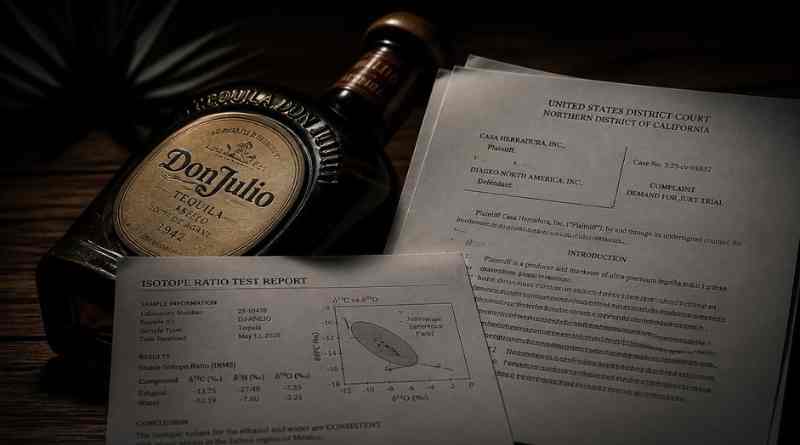
The plaintiffs allege that independent isotope testing of Don Julio and Casamigos products revealed the presence of cane alcohol at levels inconsistent with a product made exclusively from agave. Isotope ratio analysis is a scientific testing method used to distinguish between sugars derived from different plant sources based on their carbon isotope signatures. Agave produces a distinctive C4 isotope profile that differs measurably from cane sugar. The complaint relies on this testing methodology as the primary scientific basis for its allegations.
The First Lawsuit: Pusateri et al. v. Diageo North America (New York, May 2025)
The primary don julio lawsuit was filed by Hagens Berman Sobol Shapiro LLP on May 5, 2025, in the Eastern District of New York, bearing Case No. 1:25-cv-02482 before the U.S. District Court.
The named plaintiffs are Avi Pusateri, Chaim Mishulovin, and Sushi Tokyo Inc., a Brooklyn sushi restaurant. Both individual plaintiffs are from New Jersey. The complaint seeks class certification to represent all consumers who purchased Casamigos or Don Julio tequila products in New York or New Jersey during the applicable statute of limitations period.
The legal claims brought in this case include violations of New York consumer protection law, violations of New Jersey consumer protection law, and unjust enrichment. The lawsuit seeks damages, class certification, attorney fees and costs, and a jury trial.
The case does not allege physical harm to consumers. It is an economic injury case. The theory of damages is that consumers paid a premium price for a product represented to contain only expensive, labor-intensive Blue Weber agave, and if the product actually contains cheaper cane alcohol or other non-agave sources, consumers paid more than the product was actually worth.
The original class period that determines who can potentially qualify runs from approximately 2020 to 2025.
On May 6, 2026, Diageo requested a court-ordered stay of the cases pending resolution of motions to dismiss. On May 8, 2026, the plaintiffs responded opposing the stay, arguing Diageo had not made the required legal showing to justify pausing the litigation. As of June 2026, this dispute over the stay is the most recent active procedural development in the litigation. No ruling on the stay motion has been publicly reported.
The Second Lawsuit: California RICO Case (July 2025)
On July 4, 2025, a second class action was filed in the San Francisco division of the U.S. District Court for the Northern District of California. This case was filed by Baron & Budd in conjunction with Hagens Berman, the same firm that filed the New York case.
The California case was brought on behalf of plaintiff Jacqueline Jackson, a California resident who states she purchased at least four bottles of Don Julio Blanco between April and May 2025 under the belief she was paying a premium for authentic 100% agave tequila.
The California case is more expansive in scope and more aggressive in its legal theory than the New York filing. In addition to false advertising and consumer protection claims, the California complaint alleges violations of the Racketeer Influenced and Corrupt Organizations Act, commonly known as RICO. A RICO claim requires proof that the defendant engaged in a pattern of racketeering activity through an enterprise affecting interstate commerce. Applying RICO to tequila labeling is an aggressive legal strategy that, if successful, would allow for treble damages, meaning three times the actual damages, in addition to attorney fees.
The California complaint also alleges fraudulent scheming and publishes specific test results in the complaint itself, making it more detailed in its scientific allegations than the original New York case. According to the complaint, the testing showed Don Julio Blanco specifically contained measurable levels of alcohol not consistent with an exclusively agave-derived product.
The Third Lawsuit: Florida (2025)
A third class action lawsuit was also filed in Florida in 2025 as part of the expanding litigation against Diageo over the 100% agave labeling claim. The Florida case extends geographic coverage of the class action litigation beyond New York, New Jersey, and California, broadening the pool of potential class members who can participate in any eventual settlement based on purchases made in Florida.
Specific case details for the Florida filing, including the court, case number, and named plaintiff, are part of the broader consolidated litigation package being managed alongside the New York and California cases. Multiple lawsuits are described as pending against Diageo North America as of June 2026 according to the Hagens Berman case page, with the firm noting that Diageo is a global leader in the beverage alcohol industry facing claims related to its worldwide top-selling tequila brands.
What Is the Legal Standard for 100% Agave Tequila?
Understanding the don julio lawsuit requires understanding the regulatory framework that governs the 100% agave claim specifically.
Under the Norma Oficial Mexicana for tequila, commonly referred to as the NOM-006-SCFI, tequila must be produced in designated Mexican states from Blue Weber agave. Tequila labeled as 100% agave must be made exclusively from agave sugars with no addition of other sugar sources or alcohol. This is distinct from mixto tequila, which can contain up to 49% non-agave sugars by law and must be labeled accordingly without a 100% agave claim.
The U.S. Bureau of Alcohol, Tobacco, Firearms and Explosives, now the Alcohol and Tobacco Tax and Trade Bureau, requires that imported spirits comply with their country of origin standards and that all labeling claims be truthful and not misleading under U.S. federal law. If a tequila is adulterated with non-agave alcohol in Mexico and then exported and sold in the United States under a 100% agave label, both Mexican and U.S. law are potentially violated simultaneously.
The Tequila Regulatory Council, the CRT, is the body in Mexico that certifies tequila production and issues certificates of conformity. The CRT maintains that its certification processes are robust. The plaintiffs have argued that despite CRT certification, independent isotope testing reveals discrepancies that the CRT’s inspection process may not be catching, either through inadequate testing methodology, corruption, or systematic failures in the supply chain that occur after production is certified.
Diageo’s Response and Defense Position
Diageo North America has denied all allegations in the don julio lawsuit. The company maintains that its products are produced in compliance with all applicable Mexican tequila regulations and that independent certification by the CRT confirms the authenticity of its 100% agave labeling claims.
Diageo’s May 6, 2026 motion requesting a stay of the cases pending the court’s resolution of motions to dismiss indicates the company is pursuing a legal strategy of challenging the sufficiency of the complaint at the motion to dismiss stage before full discovery begins. If the motions to dismiss succeed, the case could be narrowed or dismissed before class discovery and certification proceedings occur. If they fail, the litigation moves into full discovery, which would likely include Diageo being required to produce its production records, supplier contracts, and internal testing data.
Beyond the courtroom, Diageo has significant commercial incentives to contest these allegations vigorously. Don Julio is one of the world’s best-selling luxury tequila brands. Casamigos was acquired by Diageo for $1 billion in 2017. Any finding or public admission that these products contain non-agave alcohol would be commercially catastrophic for premium brands whose entire value proposition rests on the 100% agave promise.
The Agave Industry Context: Why This Lawsuit Emerged in 2025
The don julio lawsuit did not emerge in a vacuum. It arrived during a period of significant tension in the agave and tequila industry.
In early 2025, Mexican media reported that agave growers in Mexico had organized public demonstrations against tequila companies, protesting what they described as the use of non-agave ingredients in products labeled as premium tequila. These protests reflected economic pressure on agave farmers who produce the raw material for authentic tequila production but found themselves competing with producers they believed were diluting their product with cheaper alcohol sources without disclosure.
Parallel to the farmer protests, consumer advocacy groups and spirits transparency organizations had been raising questions about industry regulatory compliance for several years. The NOM-006 standard is supposed to guarantee purity, but critics have argued that the CRT’s enforcement mechanisms have not kept pace with the explosive growth of global tequila demand. U.S. tequila sales grew dramatically through the 2010s and early 2020s, with premium and ultra-premium brands capturing an increasing share of the market. That economic growth created pressure on supply chains, and critics argue it also created financial incentives to cut corners that the existing regulatory structure was not equipped to detect.
The isotope testing methodology at the center of the lawsuit represents a relatively new tool that plaintiffs’ attorneys have brought into the spirits litigation space. When the same isotope approach was used to test specific bottles purchased in the open market and produced readings allegedly inconsistent with 100% agave production, it provided a scientific foundation for the lawsuit that did not exist a decade ago.
Who Qualifies for the Don Julio Lawsuit
If a class action settlement is eventually reached in the don julio lawsuit, eligibility will be determined by the court-approved class definition. Based on the current complaints and the class period described in filings, you are likely a potential class member if the following apply.
You purchased Don Julio tequila, Casamigos tequila, or both in the United States at any point during the class period, which based on current filings covers approximately purchases made between 2020 and 2025. You made these purchases as a consumer for personal use rather than for resale. You are a U.S. resident. You did not previously release any claims against Diageo, Don Julio, or Casamigos.
You do not need to have experienced any physical health harm. This is an economic injury class action. The injury is paying a premium price for a product you believed was made from 100% agave, when the plaintiffs allege it was not.
You do not need to have kept receipts. Most consumer class action settlements allow undocumented purchasers to self-certify purchases with a reasonable per-bottle claim cap. Documented purchasers typically receive a higher individual recovery than undocumented ones.
No class has been certified and no settlement has been announced as of June 2026. There is currently no claims portal to file through. Any website claiming you can file a Don Julio settlement claim right now should be treated with extreme caution. Do not submit personal or financial information to any third-party settlement claim site that is not officially designated by the court or claims administrator in an approved settlement notice.
What Could Class Members Recover?
No settlement amount has been announced. The New York complaint seeks over $5 million in damages as a jurisdictional threshold. The California RICO claim, if its treble damages theory succeeds, could produce a larger fund. The Florida case adds additional geographic coverage.
In comparable premium beverage false advertising class actions, individual consumer settlements have ranged from a few dollars per bottle to twenty or more dollars per bottle depending on the price premium at issue and the size of the total settlement fund relative to the number of claimants. Don Julio’s retail pricing at the time of the alleged class period ranged from approximately $45 to well over $100 per bottle depending on the expression, meaning the premium paid for the 100% agave claim is substantial relative to mass-market spirits.
What each individual class member ultimately receives depends on how many qualifying purchases are claimed against the settlement fund, whether the court certifies the class, the outcome of any motions to dismiss, the size of any negotiated settlement, and the court’s fee award to class counsel.
What to Do Right Now
If you purchased Don Julio or Casamigos tequila between 2020 and 2025 and want to be positioned to file a claim when a settlement is reached, the most practical steps you can take now are the following.
Keep any purchase records you have. Receipts, credit card statements showing spirits retailer purchases, or screenshots of online orders that include Don Julio or Casamigos products all constitute documentation that could increase your individual recovery in a settlement.
Sign up for case update alerts through Hagens Berman’s official case page at hbsslaw.com for the Casamigos and Don Julio tequila case. This is the primary law firm managing the case and their case page is the most reliable source for settlement announcements.
Do not pay anyone to file a claim on your behalf. Class action settlement claims are free to file. Any person or company charging a fee to submit your settlement claim is engaging in a practice you should avoid.
Monitor the court docket. The Eastern District of New York case, No. 1:25-cv-02482, is publicly accessible through the federal PACER system. Key developments including rulings on the motion to dismiss, class certification decisions, and any settlement announcement will appear on the docket.
Frequently Asked Questions
What is the don julio lawsuit about?
It is a class action lawsuit against Diageo North America alleging that Don Julio and Casamigos tequilas are falsely marketed as 100% Blue Weber agave while actually containing cane spirit or other non-agave alcohols. The primary case is Pusateri et al. v. Diageo North America, Inc., Case No. 1:25-cv-02482, filed May 5, 2025 in the Eastern District of New York.
How many lawsuits are there against Don Julio?
As of June 2026, there are at least three: the original New York class action filed May 5, 2025, a California RICO class action filed July 4, 2025, and a Florida class action filed in 2025. Multiple cases are described as pending against Diageo North America.
What is the current status of the Don Julio lawsuit in 2026?
On May 6, 2026, Diageo requested a stay of the cases pending resolution of its motions to dismiss. Plaintiffs opposed on May 8, 2026. No ruling on the stay has been publicly reported. No class has been certified and no settlement has been announced.
What is isotope testing and why does it matter?
Isotope ratio analysis identifies the carbon isotope signature of alcohols in a beverage. Blue Weber agave and cane sugar produce different isotope signatures. The plaintiffs allege that independent isotope testing of Don Julio and Casamigos products showed carbon signatures inconsistent with exclusively agave-derived alcohol, suggesting the presence of cane spirit.
Do I need to have saved receipts to file a claim?
No. Most consumer class action settlements allow undocumented purchasers to self-certify their purchases with a per-bottle claim cap. However, documented purchases generally produce a higher individual recovery. Save any records you have.
Has Diageo admitted any wrongdoing?
No. Diageo has denied all allegations and is actively defending all three lawsuits. The company has sought a stay of the cases while its motions to dismiss are pending.
Final Word
The don julio lawsuit represents one of the most consequential false advertising cases in the premium spirits industry in years. The 100% agave claim is not a marketing preference. It is the fundamental legal and commercial basis on which consumers pay premium prices for brands like Don Julio. If independent isotope testing supports the plaintiffs’ allegations at trial or through settlement, the financial and reputational consequences for Diageo would be severe. If Diageo’s motions to dismiss succeed, the case could end before those questions are answered.
For consumers who purchased Don Julio or Casamigos between 2020 and 2025, the most important action is preparation: keep your records, monitor official case updates through Hagens Berman’s case page, and file your claim promptly when a settlement is announced. The money in class action settlements goes to those who file, not to those who wait.
Note: This article is for informational purposes only and does not constitute legal advice.