Crepe Erase Lawsuit: Verified Facts, Billing Complaints, and the Real 2026 Legal Status
The crepe erase lawsuit topic is one of the most searched and most misreported legal subjects in the skincare consumer protection space. Here is the verified answer as of June 2026: no confirmed active nationwide class action lawsuit against Crepe Erase appears in any publicly accessible federal or state court docket. No court-approved settlement specific to Crepe Erase has been verified in any official court record. The complaints that drive searches for a crepe erase lawsuit are real, consistent, and voluminous, but they involve consumer grievances about auto-renewal billing, difficult cancellations, and unmet marketing claims rather than a confirmed certified class action with a claims process open to consumers.
What does exist is a documented history of regulatory action against Guthy-Renker LLC, the parent company behind Crepe Erase, including a $15.2 million Proactiv auto-renewal class action settlement and a 2019 CART automatic renewal settlement of $1.2 million plus $75,000 in investigative costs that covered Guthy-Renker’s subscription billing practices across all of its brands. Neither of those settlements created a current open Crepe Erase specific claims process.
What Is Crepe Erase and Who Makes It?
Crepe Erase is a line of skincare products marketed primarily to women over 50 who are experiencing crepey skin, a condition characterized by thin, wrinkled skin texture typically appearing on the arms, neck, legs, and décolletage. The product line includes body repair treatments, exfoliating pre-treatment solutions, and targeted formulas for specific areas.
Guthy-Renker LLC is the California-based direct-to-consumer marketing company behind Crepe Erase. Founded in 1988, Guthy-Renker built its business model on television infomercials and direct mail campaigns promoting subscription-based beauty and wellness products. The company has operated major direct-response brands including Proactiv, Wen Hair Care, and Crepe Erase, all of which have generated consumer complaints and legal scrutiny related to their subscription billing practices.
Crepe Erase uses endorsements from celebrities including Jane Seymour and Barbara Niven in its infomercial campaigns. The marketing presents before-and-after transformations and testimonials from women claiming dramatic improvement in the texture and appearance of their skin. The typical entry point is a discounted starter kit ranging from $39.95 to $69.95, with auto-enrollment in a recurring monthly shipment unless the customer actively cancels.
This business model, the discounted starter kit combined with automatic monthly shipments and a cancellation process that many consumers describe as difficult, is the foundation of every consumer complaint and every legal action connected to the crepe erase lawsuit topic.
The Actual Consumer Complaints Driving the Crepe Erase Lawsuit Searches
The complaints that generate crepe erase lawsuit searches fall into three consistent categories, each documented across the Better Business Bureau, the FTC complaint database, state attorney general offices, and consumer review platforms.
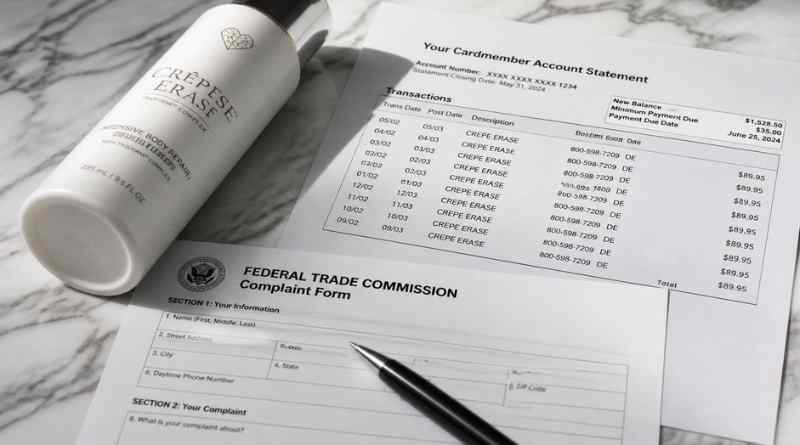
The first and most common complaint involves unauthorized or unexpected recurring billing. Consumers report ordering what they believed was a one-time starter kit and then discovering monthly charges of $79 or more appearing on their credit cards or bank statements in subsequent months. The complaint describes a disconnect between what consumers understood at the time of purchase and what the subscription terms actually required. Some consumers report discovering these charges only after two or three months of billing.
The second complaint involves difficulty canceling. Consumers describe being required to call a phone number during limited hours, being placed on hold for extended periods, being offered product credits or discounts as alternatives to cancellation, and continuing to receive shipments or charges after believing they had successfully canceled. Some report receiving new shipment invoices even after initiating chargebacks, which escalated the dispute further.
The third complaint involves refund disputes. Guthy-Renker’s stated refund policy for Crepe Erase is a 60-day money-back guarantee. Consumers report being denied refunds because they did not contact the company within the 60-day window, discovering the window had already passed by the time they identified the ongoing charges, or receiving only partial refunds that excluded shipping costs or the initial product charge.
These three patterns collectively describe the type of subscription billing conduct that regulatory agencies have repeatedly identified as a violation of the FTC’s Negative Option Rule, which requires sellers to clearly and conspicuously disclose subscription terms before purchase, obtain affirmative consent to recurring charges, and provide a simple cancellation mechanism.
The Guthy-Renker Legal History: What Courts and Regulators Have Actually Done
The verified regulatory and legal actions against Guthy-Renker LLC provide the historical context that makes the crepe erase lawsuit discussion legally meaningful even in the absence of a confirmed Crepe Erase-specific class action.
In 2017, plaintiff Jennifer Habelito filed a class action lawsuit against Guthy-Renker in California court, alleging that the company’s Proactiv subscription program failed to disclose auto-renewal terms and never required consumers to affirmatively consent to them. This was a direct-to-consumer marketing dispute over the same subscription billing model that later generated Crepe Erase complaints.
A $15.2 million settlement was preliminarily approved in that Proactiv case. Under the settlement terms, eligible class members had the option to receive a cash payment ranging from $20 to $75 or skincare products valued at $75. That settlement was for Proactiv consumers specifically, not Crepe Erase purchasers. Any Crepe Erase consumer who also purchased Proactiv during the class period may have been eligible. No Crepe Erase specific claims were covered.
In February 2019, Guthy-Renker reached a separate resolution of the CART automatic renewal task force action, which was filed in Santa Clara Superior Court. Guthy-Renker agreed to pay $1.2 million in civil penalties and $75,000 in investigative costs as part of that settlement. Importantly, the CART task force action covered Guthy-Renker’s automatic renewal billing practices across its product lines, which would include Crepe Erase. The settlement required Guthy-Renker to implement compliant automatic renewal disclosure practices across all of its brands going forward.
Following the 2019 CART settlement, Guthy-Renker made commitments to improve disclosure of auto-renewal terms and provide clearer cancellation instructions. The continued high volume of consumer complaints about Crepe Erase billing practices in the years following that settlement raises questions about whether those commitments produced lasting operational changes.
In December 2019, the National Advertising Review Board, commonly known as the NARB, issued a finding in a case involving Guthy-Renker’s Crepe Erase marketing claims. The NARB found in favor of Guthy-Renker on the advertising claims at issue at that time, meaning the regulator did not require the company to change or stop those specific marketing statements. This finding is sometimes cited by the company to support the validity of its product claims but applies only to the specific advertising reviewed in that proceeding.
Why No Confirmed Nationwide Crepe Erase Class Action Appears in Court Records
Multiple independent court record searches, conducted by legal journalists and research sources including Injury Report USA and ClassAction24 as recently as early 2026, found no active or concluded Crepe Erase specific class action lawsuit in any public federal or state court docket.
The absence of a confirmed docket entry is a meaningful finding. Class action lawsuits in federal court are publicly accessible through the PACER system. State court filings are accessible through state court databases. A $15.2 million class action settlement like the Proactiv case appears in these databases. An $8 million class action settlement would also appear.
The $8 million settlement claim appearing on certain websites cannot be traced to any confirmed court approval order, any settlement administrator announcement, or any filing in any publicly accessible court database. No case number, no court, no judge name, no settlement administrator, and no claims deadline have been consistently attached to this figure across credible sources. Multiple credible legal research sources specifically note that no confirmed nationwide Crepe Erase class action appears in available court records.
This is consistent with a pattern of content websites generating settlement claim stories for popular consumer search terms without verified underlying legal documents. The same pattern has appeared in searches related to other consumer skincare brands. Do not submit personal or financial information to any website claiming to process your Crepe Erase settlement claim without first verifying that a settlement administrator exists through an official court order published in a federal or state court database.
The FTC Regulatory Framework That Governs These Claims
Even without a confirmed certified class action, the regulatory framework governing Guthy-Renker’s subscription billing practices is real and is actively enforced.
The FTC’s Negative Option Rule, formalized under 16 CFR Part 425, specifically addresses subscription billing practices in which a consumer’s silence or inaction is treated as consent to continued charges. The rule requires sellers to clearly and conspicuously disclose all material subscription terms before the consumer agrees to purchase, including the amount and frequency of recurring charges, the deadline for canceling to avoid charges, and the cancellation mechanism. Disclosures buried in fine print, presented after the purchase decision is made, or presented in a way that is not prominently visible do not satisfy this requirement.
In 2024, the FTC implemented an updated Click-to-Cancel rule, formally titled the Negative Option Rule amendment, which requires companies offering subscription services to provide a cancellation mechanism that is at least as simple as the enrollment mechanism. A consumer who enrolled online must be able to cancel online. A company cannot require a phone call to cancel an online enrollment. A 2025 federal appeals court challenge paused implementation of certain elements of the Click-to-Cancel rule, but many companies had already begun implementing compliance measures.
California, New York, and Illinois have also enacted their own automatic renewal laws with additional consumer protections beyond the federal baseline. California’s Automatic Renewal Law, codified at Business and Professions Code Section 17600, requires affirmative consent to automatic renewal terms before any charge is made and provides consumers with a clear-language cancellation mechanism. Violations of this statute can support individual civil claims for the amount charged plus attorneys fees.
Any Crepe Erase consumer who purchased the product in California and was charged recurring fees without receiving clear automatic renewal disclosures and affirmative consent steps may have an individual claim under California’s Automatic Renewal Law independent of any class action.
What Individual Consumers Can Do Right Now
Given the absence of a confirmed crepe erase lawsuit with an open claims process, the practical options available to consumers in June 2026 are individual rather than class-based.
Contact Guthy-Renker’s customer service directly with a clear written cancellation request. Put it in writing, whether by email or certified mail, and keep a copy. A documented written cancellation request creates a verifiable record that can support a chargeback or regulatory complaint if charges continue after the request.
File a chargeback with your bank or credit card company if you have been charged after canceling. Credit card chargeback rights allow you to dispute unauthorized or continuing charges after cancellation, typically within 120 days of the charge under Visa and Mastercard rules. Provide your bank with documentation of your cancellation request and the subsequent unauthorized charges.
File a complaint with the FTC at ReportFraud.ftc.gov. FTC complaints are aggregated and used to identify patterns of conduct that support regulatory enforcement actions. The FTC does not resolve individual complaints, but a high volume of complaints about a specific company’s subscription billing practices increases the likelihood of regulatory attention.
File a complaint with your state attorney general’s consumer protection division. State AGs are authorized to bring enforcement actions under both federal and state consumer protection law, and several state attorneys general have historically taken action against direct-response marketing companies with problematic subscription billing practices.
File a complaint with the Better Business Bureau. While the BBB does not have enforcement authority, a documented complaint creates a public record and sometimes produces a resolution from the company in response to the complaint.
If you are in California and were charged recurring fees without receiving clear automatic renewal disclosures and affirmative consent steps, consult a consumer protection attorney about an individual claim under California’s Automatic Renewal Law. Many consumer protection attorneys handling these types of claims work on contingency.
How to Get a Refund From Crepe Erase Directly
If your Crepe Erase purchase is within the 60-day money-back guarantee window, contact Guthy-Renker by phone at 1-800-861-0181 or through the Crepe Erase website to request a refund. Return instructions for unused portions of the product apply. The company’s return address for Crepe Erase products is its facility in Arden, North Carolina.
If the 60-day guarantee window has passed, a direct refund request may still be worth submitting, particularly if the charge was made after a cancellation request you submitted in writing. Document your request, keep the reference number from any customer service interaction, and follow up in writing if the issue is not resolved.
Consumers who have been denied refunds after submitting valid cancellation requests, or who continue receiving charges after confirmed cancellation, have the strongest basis for a chargeback and for a regulatory complaint.
The Regulatory Enforcement Landscape in 2026
The FTC’s enforcement posture toward subscription billing practices in the beauty and skincare industry is active. In 2023 and 2024, multiple direct-to-consumer skincare and wellness brands faced FTC enforcement actions related to misleading subscription disclosures and difficult cancellation practices. The combination of the FTC’s updated Negative Option Rule and the state-level automatic renewal laws in California, New York, and Illinois creates multiple parallel enforcement pathways.
The 2019 CART settlement required Guthy-Renker to implement compliant auto-renewal disclosure practices across all of its brands. If the company’s current Crepe Erase enrollment process still fails to meet the clear and conspicuous disclosure standard required by the FTC and applicable state laws, the regulatory exposure for the company is real and ongoing.
Consumers who document their complaints through the FTC and state attorney general channels contribute to the evidentiary record that regulators use when evaluating whether enforcement action is warranted. The volume of complaints alone does not trigger action, but consistent, documented patterns of the same conduct across a large number of consumers is precisely the type of evidence that drives regulatory investigations.
Frequently Asked Questions
Is there a confirmed crepe erase lawsuit with an open claims process?
No. As of June 2026, no confirmed active nationwide class action lawsuit against Crepe Erase appears in any publicly accessible federal or state court docket. No verified settlement administrator, no confirmed settlement amount, and no open claim form exist for a Crepe Erase specific class action.
What is the $8 million Crepe Erase settlement I see online?
This figure appears on certain content websites but cannot be traced to any confirmed court approval order, case number, court name, or settlement administrator in any publicly accessible court database. Multiple independent legal research sources specifically note the absence of any confirmed Crepe Erase class action in public records. Do not submit personal information to websites claiming to process this settlement.
Has Guthy-Renker ever settled a class action?
Yes, but for a different product. The Proactiv auto-renewal class action settled for $15.2 million and covered Proactiv consumers specifically. In 2019, Guthy-Renker paid $1.2 million in civil penalties and $75,000 in investigative costs to resolve the CART automatic renewal task force action, which covered its subscription billing practices across its brands including Crepe Erase.
What can I do if I was charged without consent?
Contact Guthy-Renker in writing to cancel and request a refund, file a chargeback with your bank or credit card company, file a complaint with the FTC at ReportFraud.ftc.gov, file a complaint with your state attorney general, and consult a consumer protection attorney if you are in California and were charged without proper automatic renewal disclosures.
Are Crepe Erase’s marketing claims illegal?
The National Advertising Review Board found in favor of Guthy-Renker on specific advertising claims reviewed in 2019. The company maintains that the product functions as advertised when used as directed and that results vary by individual. The legal challenges documented against the brand relate to subscription billing practices, not product safety.
Final Word
The crepe erase lawsuit landscape in 2026 is one where the consumer grievances are real, the regulatory framework that could support legal action is strong, and the documented history of the parent company Guthy-Renker’s subscription billing problems is extensive, but no confirmed certified class action with an open claims process exists in any public court record.
For consumers who have experienced unauthorized charges, difficult cancellations, or denied refunds, the practical path runs through direct cancellation documentation, chargebacks, FTC complaints, and state attorney general filings rather than a class action claims form. For California consumers who were charged without proper automatic renewal disclosures, an individual claim under California’s Automatic Renewal Law is the most immediately viable legal avenue.
Do not act on unverified $8 million settlement claims. Do not submit personal information to third-party websites offering to process your Crepe Erase settlement. Monitor official FTC enforcement announcements and court databases for any future confirmed class action developments.
Note: This article is for informational purposes only and does not constitute legal advice. Consult a licensed consumer protection attorney for guidance specific to your situation.