
Home Depot Damage Protection Class Action: Full 2026 Status and What Renters Need to Know
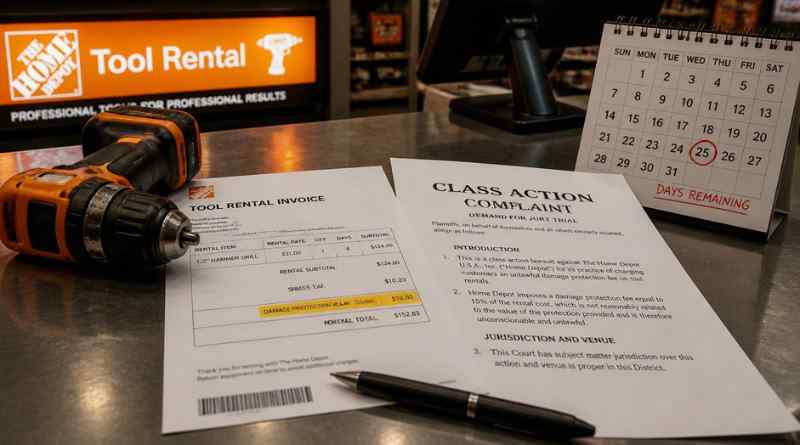
The home depot damage protection class action is a group of separate but related lawsuits filed in federal courts in Georgia challenging how Home Depot charges, discloses, and administers its tool rental damage protection fee. As of June 2026, no nationwide settlement has been reached, no consumer claims process is open, and Home Depot has disputed all allegations. The primary case, Simmons v. Home Depot USA, Inc., Case No. 1:25-cv-02409, was dismissed by a federal judge in January 2026, ruling that the plaintiff failed to state a plausible breach of contract claim. A second case, E&G Enterprise, Inc. v. Home Depot USA, Inc., Case No. 1:24-cv-03020, remains at an early procedural stage with no class certification ruling. Separate Quebec proceedings in Bitton v. Home Depot are ongoing in Canada. There is no verified claim form, no payout, and no settlement fund available to U.S. consumers as of this writing.
What Is Home Depot’s Damage Protection Fee?
Before covering the litigation, understanding the product at the center of the home depot damage protection class action is essential.
When renting tools or equipment at a Home Depot store, customers are offered a damage protection add-on at the point of sale. Historically charged at 10 percent of the rental cost, Home Depot increased the fee to 15 percent in late 2022. The fee is marketed as a waiver that relieves the renter of liability for accidental damage to the equipment during normal use.
Damage protection is not insurance. It is a contractual waiver with specific exclusions. Normal wear, intentional damage, misuse outside stated guidelines, and damage occurring in ways not covered by the contract’s definition of accidental damage may all result in the customer being billed for repairs despite having paid the protection fee. This gap between what consumers reasonably expect the protection to cover and what the contract actually covers is the foundation of the coverage-scope legal claims.
The second and more aggressive set of claims goes further. Plaintiffs allege that the damage protection fee is not truly optional at Home Depot’s point-of-sale system. According to the complaints, Home Depot’s checkout software defaults to adding the 15 percent fee to every rental invoice unless the customer actively opts out. The complaint in Simmons v. Home Depot quotes a store manager in Pelham, Alabama, who allegedly told the plaintiff that the default setting is to add the protection but that it can be taken off. Plaintiffs argue that defaulting to add an optional fee, combined with insufficient disclosure at the counter, amounts to force-placing a charge that consumers did not affirmatively select, breaching the rental contract’s language describing the protection as optional and requiring it to be selected by the customer.
Case One: The Appellate Ruling on the 25-Day Notice Requirement
The first major home depot damage protection class action to reach significant legal development involved a plaintiff challenging both the 15 percent damage protection fee and Home Depot’s calculation of late charges when equipment is returned after the rental period ends.
Home Depot’s standard rental agreement contains a clause requiring renters to provide written notice of any dispute within 25 days of the transaction date. The clause states that failure to provide timely written notice waives the right to dispute the charge.
When the plaintiff challenged both the damage protection fee and the late charges without having submitted written notice within 25 days, Home Depot moved for dismissal based on the notice requirement.
The district court ruled in Home Depot’s favor. On appeal, the U.S. Court of Appeals upheld the ruling, holding that the notice provision was unambiguous in its application to any disputed amounts, that it applied equally to the 15 percent damage protection fee and to late charges, and that the provision was neither procedurally nor substantively unconscionable. Because the plaintiff had failed to provide written notice within the 25-day window, class certification became moot. The appellate court’s ruling effectively confirmed that the 25-day notice requirement is a binding and enforceable condition of disputing any Home Depot rental charge.
This ruling has direct practical consequences for any renter considering legal action. If you rented equipment from Home Depot, were charged a damage protection fee you believe you did not select, and did not submit written notice of that dispute within 25 days of the transaction, the enforceability of that notice provision significantly limits or eliminates your ability to pursue a breach of contract claim.
Case Two: Simmons v. Home Depot USA, Inc., Case No. 1:25-cv-02409
The primary home depot damage protection class action that most consumers searching this topic are looking for is Simmons v. Home Depot USA, Inc., filed in April 2025 in the U.S. District Court for the Northern District of Georgia. The plaintiff is Randall Simmons.
The Simmons complaint focuses specifically on the force-placed nature of the damage protection fee. The complaint alleges that Home Depot’s point-of-sale system defaults to adding the 15 percent protection fee to every rental invoice. The rental contract describes the service as optional and states it must be selected by the customer in order to be charged. Simmons argues that adding the fee by default rather than requiring affirmative selection breaches the contract’s own language.
In January 2026, a federal judge dismissed the Simmons case. The court ruled that the plaintiff failed to state a plausible claim for breach of contract. The judge held that the 15 percent fee was sufficiently itemized and disclosed in the rental documentation and noted that many plaintiffs in similar cases failed to satisfy the contractually required 25-day written notice requirement for disputing charges.
The Simmons dismissal is a significant setback for the home depot damage protection class action litigation, but it is not a final, unappealable resolution. The plaintiff has the option to amend the complaint and refile in response to the court’s ruling, or to appeal the dismissal to the Eleventh Circuit. As of June 2026, no public record of an amended complaint or appeal filing in Simmons has been confirmed.
Case Three: E&G Enterprise, Inc. v. Home Depot USA, Inc., Case No. 1:24-cv-03020
The third active case in the home depot damage protection class action landscape is E&G Enterprise, Inc. v. Home Depot USA, Inc., filed in July 2024 in the Northern District of Georgia under Case No. 1:24-cv-03020.
As of January 2026 reporting, this case remained at an early procedural stage. No ruling on class certification has been issued, no ruling on the merits has been entered, and no settlement filing appears in the public docket.
The E&G Enterprise case focuses on two distinct issues within the tool rental program. First, it challenges the default opt-in practice for the damage protection fee, consistent with the Simmons allegations. Second, it specifically challenges how Home Depot calculates late charges when equipment is returned after the rental period ends, alleging that the methodology used to calculate those charges is inconsistent with the rental agreement’s terms.
Both the Simmons and E&G Enterprise cases rely on standardized rental contracts used across Home Depot stores nationwide, which is the factual foundation for seeking nationwide class certification. Both complaints emphasize that the same uniform checkout software and the same fee application practices occur in every Home Depot tool rental department in the country.
The Canadian Proceedings: Bitton v. Home Depot
Separate from the U.S. federal litigation, proceedings in Quebec under Bitton v. Home Depot are ongoing. The Canadian case raises similar allegations about damage protection fee practices in the context of Canadian consumer protection law. The Bitton case is proceeding independently under Quebec law and has no direct legal connection to the U.S. class actions. A resolution or ruling in the Canadian proceedings would not create a U.S. consumer claims process.
The 25-Day Notice Requirement: The Most Dangerous Provision for Renters
The 25-day written notice requirement embedded in Home Depot’s rental agreement has proven to be the most effective defense tool in every home depot damage protection class action filed so far. Understanding exactly what this provision requires is critical for any current or future renter.
Home Depot’s standard tool rental agreement requires that any dispute over charges be raised in writing and submitted to Home Depot within 25 days of the transaction date. A transaction date in the rental context typically means the date the rental was completed and the final invoice was generated, not the date of the initial rental.
Failure to provide written notice within this window is treated by the courts as a waiver of the right to dispute the charge. The appellate court that upheld the first dismissal confirmed that this provision applies to any disputed amount, including the damage protection fee itself and any late charges.
For renters who are charged the damage protection fee and believe they did not select it, the immediate practical action is to submit written notice of the dispute to Home Depot within 25 days of the invoice date. Keep a copy of that written notice and document how it was delivered. Email with a delivery receipt, certified mail with return receipt requested, or any method that creates a verifiable record of timely delivery is appropriate.
Submitting written notice within 25 days preserves your legal options without committing you to any specific legal action. It simply keeps the door open. Failing to do so within the window closes it.
What Constitutes Damage Protection: Coverage vs. Expectation
A significant portion of the home depot damage protection class action litigation addresses the gap between what consumers reasonably expect the fee to cover and what the contract actually provides.
Damage protection at Home Depot is a contractual waiver, not a blanket insurance policy. The specific terms of what is waived and what is not are defined in the rental agreement, not in the marketing language used at the point of sale. Exclusions commonly include intentional damage, misuse of equipment outside its intended function, damage to third-party property, theft, and damage characterized as resulting from conduct outside the scope of normal use.
The reasonable consumer standard that courts apply to assess these claims asks whether an average person, based on the marketing language and disclosures provided at the point of sale, would reasonably believe that the protection covered more than it actually does. If the marketing language created an impression of broader coverage than the contract delivers, that gap supports a consumer protection claim even if the contract itself is technically clear.
Plaintiffs in the coverage-scope claims argue that the language used to describe the protection at the rental counter and in Home Depot’s promotional materials implied comprehensive accidental damage coverage that the fine print of the rental agreement did not actually deliver. Courts reviewing these claims examine both the marketing language and the contract language, and the plaintiff must show that a reasonable consumer would have been misled.
What Customers Report: The Real-World Experience
A consistent pattern of consumer complaints about the home depot damage protection class action has emerged through court filings, online forums, and verified customer accounts that are cited in the complaints themselves.
The most frequently reported experience is discovering the damage protection fee on the final invoice after believing it had been declined at the counter. Customers report that the fee appeared on their bill without a clear recollection of having selected it, consistent with the complaints’ allegations about Home Depot’s default opt-in system.
A second frequently reported experience involves having the damage protection fee on the invoice and then being charged for damage repairs anyway, on the theory that the specific damage that occurred fell outside the protection’s scope. For renters who paid the 15 percent fee specifically to avoid damage liability, receiving a separate repair bill creates an experience of having paid for protection that provided no actual protection.
A third pattern involves late fees. Customers report that the methodology used to calculate late charges when equipment is returned after the rental period significantly exceeded what they expected based on the rental agreement’s stated daily and weekly rates, producing late fee invoices that felt disproportionate to the delay in return.
These consumer accounts, while not individually verified in the litigation, are cited in class action complaints to establish the pattern of uniform practices that forms the basis for seeking class certification.
Is There a Home Depot Damage Protection Settlement or Claim Form Right Now?
The direct answer to the most searched question in the home depot damage protection class action topic is no.
As of June 2026, there is no approved nationwide settlement against Home Depot for damage protection fee practices. There is no official claim form. There is no payout process. There is no settlement fund available to U.S. consumers.
The Simmons case was dismissed in January 2026. The E&G Enterprise case is at an early procedural stage with no rulings. No other nationwide or multidistrict class action concerning the 15 percent damage protection fee has produced an approved settlement or refund as of this date according to a review of public court dockets.
Any website claiming you can file a Home Depot damage protection settlement claim right now and receive a payout is providing unverified information. Do not submit personal or financial information to any third-party website offering to process your Home Depot settlement claim. There is no verified settlement administrator for this case.
If a settlement is eventually reached in the E&G Enterprise case or in any future proceeding, you will receive notice by mail or email if you are a class member, or a formal class notice will be published in accordance with the court’s approval order. That is the only legitimate source of claim filing instructions.
Who Would Qualify If a Settlement Is Reached
If the E&G Enterprise case or a future proceeding achieves class certification and produces a settlement, eligibility based on current complaint definitions would broadly cover the following.
Any person or business entity that rented tools or equipment from a Home Depot store in the United States and was charged a damage protection fee during the class period, which based on current filings covers rentals made from approximately 2022 onward when the fee was increased to 15 percent. Renters who were charged the fee on a default basis without providing affirmative opt-in selection would be the primary target class. Renters who subsequently received damage repair invoices despite having paid the damage protection fee would have a secondary coverage-scope claim.
You do not need to have contested the charge at the time of rental to qualify as a class member. The class is defined by the common practice, not by individual protests at the rental counter. However, the 25-day notice provision discussed throughout this article is a significant individual eligibility complication that courts have enforced. Renters who did not submit written notice within 25 days of the transaction may face additional barriers even if a class is eventually certified.
What to Do If You Were Charged the Damage Protection Fee Without Consent
If you rented equipment from Home Depot and believe the damage protection fee was added to your invoice without your affirmative selection, take the following steps.
Locate your rental invoice and note the transaction date. Calculate whether 25 days have passed since that date. If 25 days have not yet passed, send written notice to Home Depot immediately disputing the charge. Include your rental invoice number, the date of the rental, the amount of the damage protection fee charged, and a clear statement that you dispute the charge on the grounds that you did not affirmatively select the protection. Keep a copy and document delivery.
If more than 25 days have passed since the transaction date, the notice window has closed. Your breach of contract options based on the current state of the litigation are significantly limited. This does not mean no claim exists, but the contractual notice defense has been upheld by an appellate court and would likely be raised against any individual claim.
Monitor the E&G Enterprise case docket through the federal court’s PACER system. Case No. 1:24-cv-03020 in the Northern District of Georgia is publicly accessible. Any class certification ruling, settlement announcement, or major procedural development will appear on that docket before it appears anywhere else.
Do not pay anyone to file a claim on your behalf. If a settlement is eventually reached and a claims process opens, filing will be free.
Frequently Asked Questions
What is the home depot damage protection class action?
It is a group of class action lawsuits filed in federal courts challenging Home Depot’s damage protection fee on tool rentals. The lawsuits allege that the 15 percent fee is added by default without affirmative customer consent, that the coverage is narrower than what marketing implies, and that late charge calculations are inconsistent with rental agreement terms.
Is there a settlement I can file for right now?
No. As of June 2026, no nationwide settlement has been approved, no claim form is available, and no payout fund exists. The primary Simmons case was dismissed in January 2026. The E&G Enterprise case is at an early procedural stage.
What happened to the Simmons v. Home Depot lawsuit?
It was filed in April 2025 in the Northern District of Georgia, Case No. 1:25-cv-02409. A federal judge dismissed it in January 2026, ruling that the plaintiff failed to state a plausible breach of contract claim and that the fee was sufficiently itemized and disclosed in the rental documentation.
What is the 25-day notice requirement?
Home Depot’s rental agreement requires renters to submit written notice of any disputed charge within 25 days of the transaction date. Courts have enforced this provision and used it to dismiss claims from renters who failed to dispute charges in writing within the 25-day window.
What cases are still active?
E&G Enterprise, Inc. v. Home Depot USA, Inc., Case No. 1:24-cv-03020, filed in the Northern District of Georgia in July 2024, remains at an early procedural stage as of June 2026 with no class certification ruling and no settlement.
How do I protect my legal options if I was charged this fee recently?
Submit written notice to Home Depot within 25 days of your invoice date, disputing the damage protection fee. Keep a copy and document delivery. This preserves your legal options without committing you to any specific legal action. After 25 days, the contractual notice window closes.
Final Word
The home depot damage protection class action is a live and evolving area of consumer protection litigation, but as of June 2026, it has not produced a consumer settlement, a claim form, or any payout. The primary Simmons case was dismissed. The E&G Enterprise case remains in early proceedings. The 25-day notice requirement has proven to be Home Depot’s most effective defense tool, ending multiple claims before they reach class certification.
For renters who were recently charged the damage protection fee without consent, the 25-day written notice window is the most time-sensitive action item. Miss it and your contractual options narrow significantly. Meet it and you preserve your position for any future legal development.
Note: This article is for informational purposes only and does not constitute legal advice. Consult a licensed attorney for guidance specific to your situation.