Four Lakes Task Force Assessments Lawsuit: Complete 2026 Guide
The four lakes task force assessments lawsuit is resolved at the state court level. On April 11, 2025, the Michigan Supreme Court denied the Heron Cove Association’s application for leave to appeal, ending the primary legal challenge to the $217.7 million special assessment district covering roughly 8,000 properties in Midland and Gladwin counties. Property owners began receiving assessment bills in December 2025, with annual payments typically ranging between $1,200 and $2,500 per year over a 40-year period. However, the legal story surrounding the 2020 dam failures is not fully closed. A separate civil trial against the State of Michigan began in January 2026 over the $175 million in damages caused by the Edenville and Sanford dam failures, and on April 23, 2026, a Court of Claims judge ruled in favor of the state, finding the state was not liable for the flood damage. That ruling is expected to be appealed.
This article covers the complete timeline, every court ruling, the legal basis for the assessments, who is affected, what property owners are paying, and the full status of all related litigation as of June 2026.
What Are the Four Lakes and What Happened in May 2020?
The Four Lakes are Wixom Lake, Sanford Lake, Secord Lake, and Smallwood Lake, located in Gladwin and Midland counties in mid-Michigan. All four are artificial lakes created by hydroelectric dams on the Tittabawassee River system built in the early twentieth century and owned for decades by Boyce Hydro Power LLC.
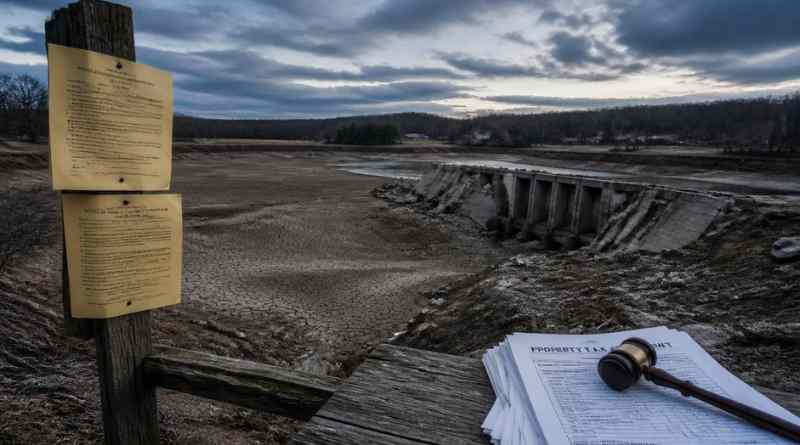
On May 19, 2020, following days of heavy rain, the Edenville Dam failed catastrophically. The Sanford Dam failed shortly after. The collapse sent floodwaters through Midland County at a scale that damaged or destroyed 2,500 homes and businesses and caused approximately $175 million in property damage across Gladwin, Midland, and Saginaw counties. Wixom Lake and Sanford Lake drained entirely. Upstream, Secord Lake and Smallwood Lake also suffered damage to their dam structures.
An independent forensic review completed in 2022 concluded that the dam failures were foreseeable and preventable. Boyce Hydro had lost its federal FERC operating license in 2018 over longstanding failure to address inadequate spillway capacity. Enforcement of dam safety standards then passed to the State of Michigan, which became the central target of subsequent civil litigation once Boyce Hydro filed for Chapter 11 bankruptcy protection in July 2020.
What Is the Four Lakes Task Force?
The Four Lakes Task Force, referred to throughout litigation as the FLTF, is a nonprofit organization that was created by Gladwin and Midland counties to manage the recovery, reconstruction, and long-term operation of the four dams and lakes. The FLTF was delegated authority by county agreement in June 2020 to coordinate recovery of lakes and shoreline properties from the dam failures.
In December 2020, a federal bankruptcy court judge granted a motion allowing the FLTF to acquire title to the Boyce Hydro properties through condemnation. The FLTF became the owner of all four dam sites and the surrounding lake infrastructure and immediately began planning and coordinating what became a reconstruction project now estimated to approach $400 million in total cost.
To fund that reconstruction, the FLTF and the county governments needed a sustainable long-term funding mechanism. They found it in special assessment law under Michigan’s Inland Lake Level Act, abbreviated as the ILLA. Under that statute, counties can create a special assessment district, levy annual fees on properties within the district that benefit from the lake, and issue municipal bonds against that revenue stream to finance capital improvements.
The Special Assessment: What It Is and What It Costs
In February 2024, Midland and Gladwin counties approved the 2025-2026 assessment rolls establishing both a capital assessment and a maintenance assessment for the Special Assessment District covering the Four Lakes area.
The capital assessment totals $217.7 million and is designed to fund the cost of reconstructing the four dams. This assessment is levied annually over a 40-year period against properties in the district. Annual bills for individual property owners typically range between $1,200 and $2,500 depending on the property’s assessed value and proximity to the lakes. Some properties with higher valuations face annual bills that can reach higher than that range.
The maintenance assessment is a separate, additional charge covering ongoing operational and maintenance costs from 2025 through 2029. It is separate from and in addition to the 40-year capital assessment.
Property owners began receiving their first capital assessment bills on their winter 2025 tax statements in December 2025. For homeowners who were already dealing with property damage from the 2020 floods and years without a functional lake, these bills arrived as a significant additional financial burden.
The Heron Cove Association Lawsuit: Full Timeline
The four lakes task force assessments lawsuit was driven primarily by the Heron Cove Association, a group of approximately 2,000 property owners who opposed the special assessment structure. Their legal campaign ran through multiple courts across three years before finally ending at the Michigan Supreme Court in April 2025.
In March 2024, the Heron Cove Association filed two separate lawsuits in Midland County Circuit Court and Gladwin County Circuit Court, alleging that the special assessment process violated constitutional protections and that the methodology used to calculate individual property assessments was flawed and disproportionate to actual benefit received.
Construction by the FLTF was suspended in March 2024 while the litigation proceeded, creating a significant delay in dam reconstruction and extending the period during which upriver property owners remained without functional lakes.
In June 2024, a Midland County Circuit Court judge upheld the assessment. The HCA appealed.
On January 6, 2025, the Michigan Court of Appeals issued a unanimous decision affirming the county’s assessment process. The appellate court held that Midland and Gladwin counties followed the law in establishing the assessments under the ILLA and found that the appellants failed to provide evidence that their property values would not increase following the lake’s return. Courts concluded that the FLTF and the counties had met all required procedural due process requirements.
In parallel, the Heron Cove Association had also filed a federal lawsuit. In March 2025, U.S. District Judge Matthew Leitman dismissed the federal case.
On April 11, 2025, the Michigan Supreme Court denied the HCA’s application for leave to appeal, finding that the questions presented did not warrant further review. This decision provided the legal finality required for the FLTF to secure long-term municipal bond financing and resume full construction operations.
FLTF President Dave Kepler described the Supreme Court ruling as excellent news for the Four Lakes communities and stated the organization would seek funding to resume construction immediately following the decision.
As of February 2026, construction had reached substantial completion on three of the four dams.
The Separate Civil Trial Against the State of Michigan: January 2026
While the four lakes task force assessments lawsuit ended with the April 2025 Supreme Court ruling, a separate and much larger civil trial against the State of Michigan began in Grand Rapids on January 12, 2026.
This case is a class action brought on behalf of roughly 2,000 flood victims in Gladwin, Midland, and Saginaw counties. The plaintiffs alleged that the state knew of longstanding safety deficiencies at the Edenville Dam, particularly the dam’s inadequate spillway capacity, and failed to take effective action to hold Boyce Hydro accountable. Their central legal theory was inverse condemnation, arguing that Michigan’s regulatory actions effectively took property value from the flood victims without compensation through a formal eminent domain process.
Plaintiffs’ attorney Thomas Waun argued in opening statements that the state’s actions were directly causative. Specifically, just two weeks before the May 19, 2020 flood, Michigan regulators approved a Boyce Hydro permit application to raise water levels on Wixom Lake from 670 feet to 670.5 feet, increasing water pressure on the already-deficient dam. Waun argued that the state was pressured to allow higher lake levels by both the DNR’s interest in protecting a native mussel species in the Tittabawassee River and by the Four Lakes Task Force itself, which wanted higher lake levels maintained for the benefit of lakefront property owners.
The state’s defense attorney Nathan Gamble responded that the state had no control over the privately owned dam. Gamble argued that Boyce Hydro employees did not report to any state agency, that the DNR had sent multiple orders to Boyce that were ignored, and that an independent forensic analysis concluded that pre-lowering Wixom Lake would very likely have been too small to prevent the dam failure in any event. Gamble argued the evidence supported a ruling in favor of the state.
On April 23, 2026, Court of Claims Judge James Robert Redford issued his ruling in favor of the State of Michigan. Judge Redford found that the residents had not met the legal standard for inverse condemnation, which required them to prove that the state took overt action specifically directed at their properties, abused its governmental power, and substantially caused their permanent property loss. While acknowledging the gravity of the losses, Judge Redford wrote that the court recognizes these losses and that they are real and lasting, but ultimately found the state not liable under the applicable legal standard.
This ruling is widely expected to be appealed. Attorney Ven Johnson, who has represented flood victims throughout the litigation, has accused the state of intentionally delaying the legal process and avoiding accountability throughout the multi-year proceeding.
The Boyce Hydro Federal Judgment: November 2023
One important financial thread in the broader Four Lakes legal landscape was resolved in November 2023. On November 27, 2023, a federal judge ruled that Boyce Hydro Power LLC and its related entities were liable for nearly $120 million in damages to the State of Michigan stemming from their mismanagement of the Edenville and other dams. Michigan had sued Boyce Hydro seeking fines for the destruction of natural resources and for gross mismanagement.
However, Boyce Hydro had filed for Chapter 11 bankruptcy in July 2020 almost immediately after the dam failures. Collecting against a bankrupt entity with limited assets is a separate and difficult process. The $120 million judgment establishes liability but the practical recovery for the state and for flood victims through Boyce Hydro’s bankruptcy estate has been limited.
What the Assessment Means for Property Owners in 2026
For the approximately 8,000 property owners in the Four Lakes Special Assessment District, the legal picture as of June 2026 is settled on the assessment question and unsettled on the broader damage recovery question.
The four lakes task force assessments lawsuit is over. The Supreme Court’s April 2025 ruling ended that legal track. The $217.7 million capital assessment is legally valid and in force. Property owners are obligated to pay their annual assessment bills. The first bills arrived in December 2025 and annual bills will continue for the remaining 39 years of the 40-year assessment period.
For property owners who want to understand what the assessment covers and how it was calculated, the FLTF publishes detailed information through its official website at four-lakes-taskforce-mi.com. The assessment calculation methodology, the bond financing structure, and the construction project updates are all publicly available.
For property owners who suffered flood damage and are hoping for financial recovery from the state’s civil trial outcome, the April 2026 Court of Claims ruling in favor of the state was a significant setback. An appeal to the Michigan Court of Appeals is the next available legal avenue. Given the scale of the case and the number of plaintiffs involved, an appeal is expected.
The Legal Standard That Determined the Assessment Lawsuit Outcome
Understanding why the courts consistently upheld the four lakes task force assessments lawsuit against the HCA requires understanding Michigan’s Inland Lake Level Act and the legal standard it establishes for special assessment districts.
Under the ILLA, counties have broad statutory authority to establish lake level orders and to fund those orders through special assessments on benefiting properties. The legal standard for challenging such an assessment requires the objecting property owner to demonstrate either that the procedural requirements for establishing the assessment were not followed, or that the property will receive no benefit from the improvement being funded.
The HCA’s core argument was that individual property owners were being asked to pay too much relative to the benefit they would receive. Courts at every level found that the HCA failed to present sufficient evidence to meet that standard. The Michigan Court of Appeals specifically noted that the appellants provided no evidence that their property values would not increase following the lake’s return to normal levels. Restoration of functional lakefront status to properties that lost their lakefront entirely in May 2020 represents a quantifiable and substantial benefit, and that benefit argument was the foundation of every court ruling that upheld the assessment.
What Happens Next: Remaining Legal Questions in 2026
As of June 2026, there are two unresolved legal threads in the broader Four Lakes litigation landscape.
The first is the expected appeal of the April 23, 2026 Court of Claims ruling that found the State of Michigan not liable for the flood damage. If flood victims’ attorneys pursue an appeal, the case would move to the Michigan Court of Appeals. A Court of Appeals ruling adverse to the state could reopen the damages question and potentially lead to a settlement or further proceedings.
The second is the ongoing collection against Boyce Hydro’s bankruptcy estate related to the $120 million federal judgment issued in November 2023. Bankruptcy proceedings are slow and recovery from a depleted estate is uncertain, but the judgment remains in force and creditors including the state continue to pursue collection.
Construction on the four dams continues under FLTF management. Three of the four dams reached substantial completion in early 2026. Full restoration of all four lakes is dependent on completing the fourth dam and successfully filling the lakes to their intended levels. The FLTF estimates the total project cost will approach $400 million when complete.
Frequently Asked Questions
What is the four lakes task force assessments lawsuit?
It is a legal challenge filed by the Heron Cove Association, a group of approximately 2,000 property owners in Midland and Gladwin counties, against the $217.7 million special assessment district established by the Four Lakes Task Force and county governments to fund reconstruction of four Michigan dams destroyed in the May 2020 floods. The lawsuit was finally resolved on April 11, 2025, when the Michigan Supreme Court denied the HCA’s application for leave to appeal.
Is the Four Lakes Task Force assessments lawsuit still active in 2026?
No. The assessment lawsuit ended with the Michigan Supreme Court’s April 2025 ruling. The $217.7 million capital assessment is legally in force. Property owners began receiving bills in December 2025. A separate civil trial against the State of Michigan over the flood damages concluded with a ruling in favor of the state on April 23, 2026, and an appeal of that ruling is expected.
How much are property owners paying in the Four Lakes assessment?
Annual payments under the 40-year capital assessment typically range between $1,200 and $2,500 per year depending on the assessed value of the property. There is also a separate maintenance assessment covering 2025 through 2029. Bills began arriving on winter 2025 tax statements in December 2025.
Did the courts ever rule that the Four Lakes assessments were illegal?
No. Every court that reviewed the assessment, including the Midland County Circuit Court, the Michigan Court of Appeals, and ultimately the Michigan Supreme Court, upheld the assessments as legally valid under Michigan’s Inland Lake Level Act.
What happened to Boyce Hydro, the company that owned the Edenville Dam?
Boyce Hydro filed for Chapter 11 bankruptcy in July 2020 following the dam failures. A federal judge issued a $120 million judgment against Boyce Hydro in favor of the State of Michigan in November 2023. The FLTF acquired the dam properties through condemnation in the bankruptcy proceedings. Collection of the federal judgment against Boyce Hydro’s bankruptcy estate is ongoing.
What was the result of the 2026 civil trial against the State of Michigan?
The class action trial began in Grand Rapids on January 12, 2026. Court of Claims Judge James Robert Redford ruled in favor of the State of Michigan on April 23, 2026, finding that flood victims had not proven inverse condemnation under the applicable legal standard. The ruling acknowledged the real and lasting nature of the losses but found the state not legally liable. An appeal of this ruling is expected.
Final Word
The four lakes task force assessments lawsuit concluded in April 2025 with a definitive Michigan Supreme Court ruling upholding the $217.7 million special assessment district. That legal track is closed. What remains open is the broader question of accountability for the May 2020 flood disaster that triggered everything. The April 2026 Court of Claims ruling in favor of the state represents a significant legal setback for the approximately 2,000 flood victims who brought that case. Given the scale of destruction, the documented history of the dam’s deficiencies, and the five-plus years of litigation investment by plaintiffs’ counsel, an appeal to the Michigan Court of Appeals is the logical next step.
For property owners in the assessment district, the financial obligation is now clear and legally settled. The 40-year payment schedule has begun. The dams are being rebuilt. Three of four are substantially complete. Whether the people who caused this disaster will ultimately be held financially accountable for the full scope of its impact remains the defining unresolved question of the entire Four Lakes legal saga.
Note: This article is for informational purposes only and does not constitute legal advice. Property owners with specific questions about their assessment obligations or legal options should consult a licensed Michigan attorney.